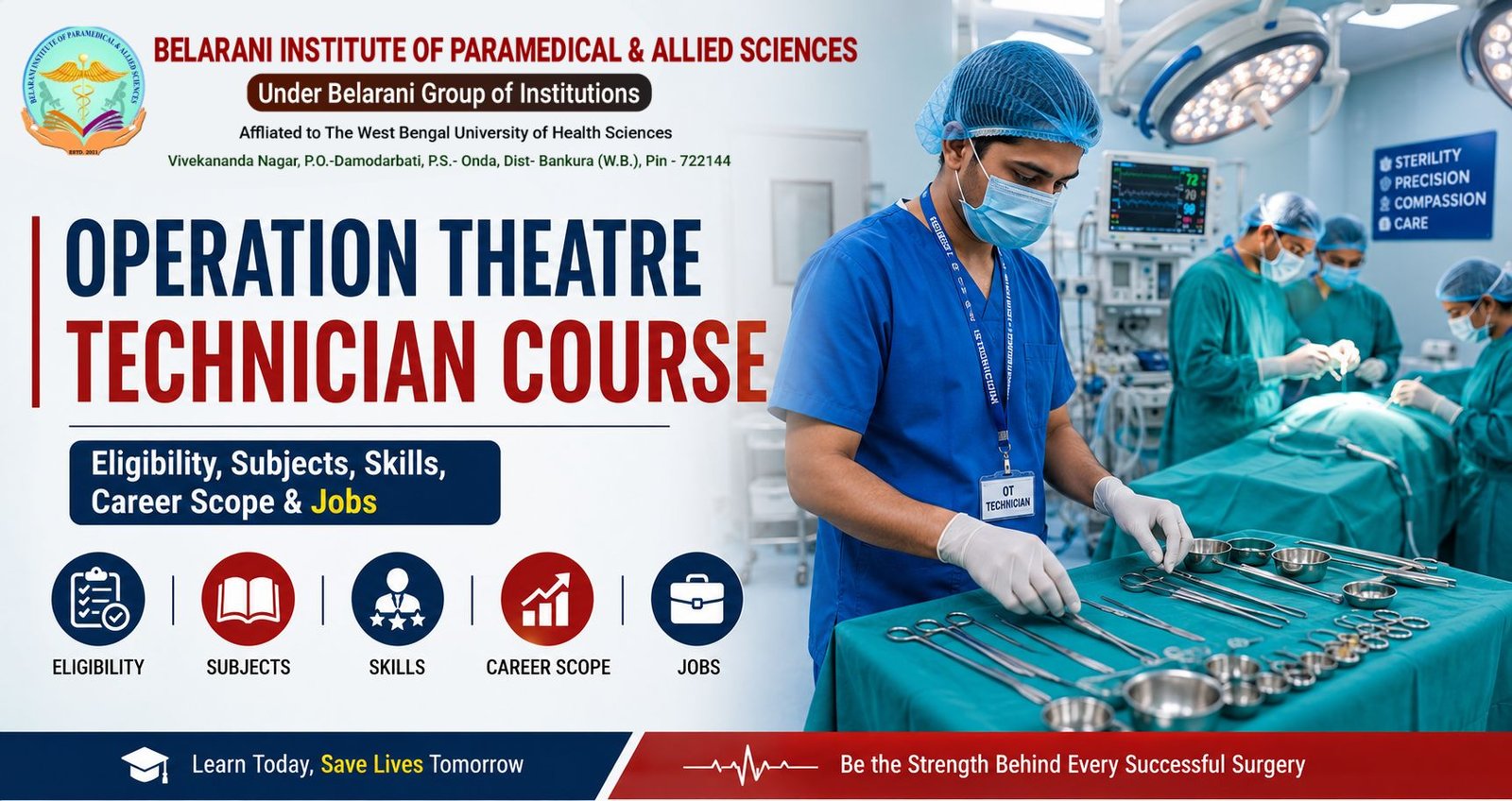
If you want a healthcare career that combines medical knowledge, technology, teamwork, and hands-on responsibility, an operation theatre technician course can be an exciting choice. Operation Theatre Technicians (OTT) work alongside surgeons, anaesthetists, nurses, and other healthcare professionals to keep surgical procedures safe, organised, and efficient. Their work begins before surgery and continues through recovery and post-operative support.
Belarani Institute of Paramedical & Allied Sciences in Onda, Bankura, offers a B.Sc. in Operation Theatre Technology with academic and practical learning.
What Is an Operation Theatre Technician Course?
An operation theatre technician course prepares students to support surgical teams and manage the technical and clinical requirements of an operation theatre. Training generally covers surgical instruments, patient preparation, sterilisation, infection prevention, anaesthesia support, emergency procedures, theatre management, and safe handling of equipment.
The role is not limited to passing instruments. A trained technician helps prepare the theatre, checks equipment and supplies, maintains sterile conditions, supports the surgical team during procedures, and assists with post-operative arrangements. Strong attention to detail and calm decision-making are therefore essential.
Operation Theatre Technician Course Eligibility
Eligibility varies according to the programme and institution. For many undergraduate operation theatre technology programmes, students need to complete Class 12 with Physics, Chemistry, and Biology or Mathematics. Some institutions specify minimum marks, while admission may be based on merit or an entrance process.
At Belarani Institute, the B.Sc. Operation Theatre Technology pathway is designed for students seeking professional training in this specialised allied healthcare field. Applicants should always check the latest admission notification, university requirements, and applicable counselling rules before applying.
Course Duration and Learning Format
The duration depends on the qualification. Diploma, certificate, and undergraduate programmes can have different structures. A B.Sc.-level operation theatre technology programme commonly combines classroom teaching, practical training, clinical exposure, and internship.
This blend matters because OT work is highly practical. Students learn how anatomy, microbiology, sterilisation, surgical preparation, and equipment handling influence patient safety.
Operation Theatre Technician Course Subjects
The syllabus can differ between universities, but students can expect subjects such as:
- Human Anatomy and Physiology
- Microbiology and Pathology
- Biochemistry and Pharmacology
- Surgical Procedures and Techniques
- Anaesthesia Technology
- Surgical Instruments and Equipment
- Sterilisation and CSSD procedures
- Infection Control and Patient Safety
- Operation Theatre Management
- Emergency and Critical Care basics
- Medical Ethics and Communication
- Clinical Training and Internship
Together, these subjects develop both scientific understanding and practical readiness. Students also learn how to maintain discipline, documentation, hygiene, teamwork, and professional conduct in a clinical environment.
Skills You Develop During the Course
Technical knowledge is only one part of becoming a successful operation theatre technician. Students should develop precision, observation, communication, teamwork, time management, and emotional stability. An OT can be fast-paced, so professionals must follow protocols carefully and respond appropriately to instructions.
Another important skill is equipment awareness. Modern operation theatres use monitors, surgical devices, anaesthesia equipment, and specialised systems. Understanding their safe operation supports workflow.
Career Scope After Operation Theatre Technology
The healthcare sector needs trained professionals who can support surgical services in hospitals, nursing homes, trauma centres, emergency facilities, and specialised healthcare institutions. Career opportunities may include Operation Theatre Technician, OT Technologist, Anaesthesia Technician, Surgical Assistant, CSSD Technician, and OT Coordinator, depending on qualification, employer requirements, and experience.
With experience and additional education, professionals can move towards supervisory, administrative, teaching, or specialised technical roles. Continuous learning remains important as procedures, equipment, and healthcare standards evolve.
Where Can Operation Theatre Technicians Work?
Graduates can explore opportunities in government hospitals, private hospitals, multispeciality hospitals, surgical centres, trauma and emergency units, day-care surgery facilities, and other clinical settings. Some professionals may also work in central sterile supply departments or areas supporting critical care and anaesthesia services.
For students from Bankura and nearby areas, studying locally can provide a practical route into allied healthcare. Belarani Institute offers laboratories, smart classrooms, a library, and a ragging-free campus.
Why Choose This Career?
An operation theatre technician career suits students who enjoy biology, healthcare technology, teamwork, and practical responsibilities. It offers the opportunity to contribute to patient care while working as part of a specialised medical team.
However, this profession demands discipline. Technicians must respect sterile protocols, maintain concentration, communicate clearly, and understand that even a small mistake can affect a procedure. Students should therefore choose an institute that balances theory with practical and clinical learning.
FAQs:
Is an operation theatre technician a doctor?
No. An operation theatre technician is an allied healthcare professional who supports surgeons, anaesthetists, nurses, and the wider surgical team. They do not independently perform surgery or replace a doctor.
What does an OT technician do?
An OT technician prepares the theatre, instruments, equipment, and supplies; supports sterile procedures; assists the surgical team; helps with anaesthesia-related equipment under appropriate supervision; and contributes to patient safety and post-operative arrangements.
Is Biology necessary for an operation theatre technician course?
For many undergraduate programmes, Biology is required or included among accepted science subjects. However, eligibility differs by institution, so students should verify the specific programme requirements before admission.
What is the scope of an operation theatre technician course?
The scope includes roles in hospitals, surgical centres, trauma facilities, emergency departments, CSSD units, and other healthcare organisations. Higher qualifications and experience can support career progression.
Start Your Healthcare Career with Training
Choosing an operation theatre technician course is more than selecting a job-oriented programme; it is choosing a profession built around precision, patient safety, teamwork, and responsibility. If you are planning a career in allied healthcare, compare the syllabus, practical facilities, clinical exposure, eligibility, academic support, and progression opportunities before enrolling.
Belarani Institute of Paramedical & Allied Sciences in Onda, Bankura, provides an academic environment for students interested in Operation Theatre Technology. Explore the programme, understand the admission requirements, and take an informed step toward a healthcare career.
Read More: