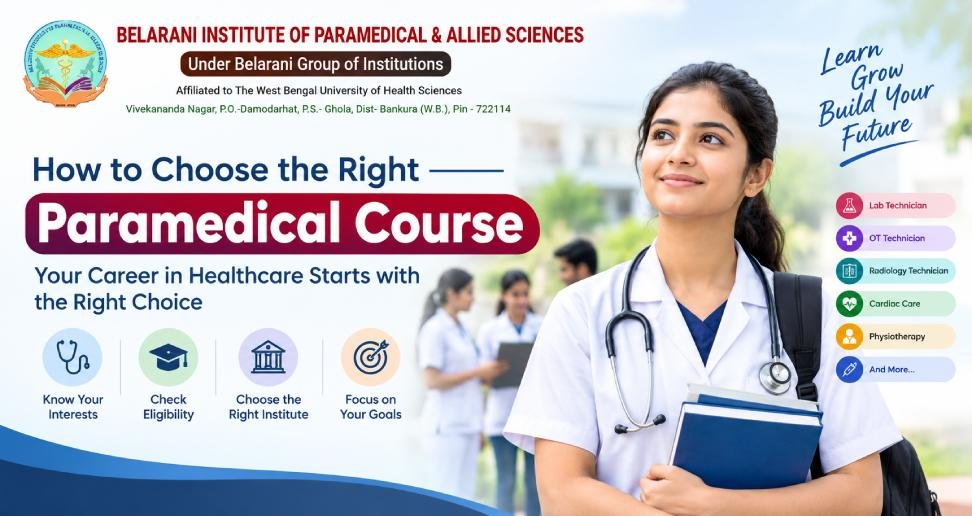
Choosing a career in healthcare is a major decision, especially for students who want to work in the medical field but are not planning to become doctors. Paramedical courses offer excellent opportunities to build a career in hospitals, diagnostic centers, laboratories, emergency care, rehabilitation, and other healthcare settings. However, with so many courses available, selecting the right one can sometimes be confusing.
Before enrolling in any program, students should understand their interests, career goals, course eligibility, practical training, and future opportunities. This guide explains how to choose the right paramedical course and what factors should be considered before making a final decision.
What Is a Paramedical Course?
Paramedical courses are healthcare-related programs that prepare students for specialized roles that support doctors, nurses, and other medical professionals. Paramedical professionals play an important role in diagnosis, patient care, medical testing, emergency services, rehabilitation, and other healthcare functions.
Depending on the specialization and academic level, students can choose certificate, diploma, undergraduate, or postgraduate paramedical programs. Popular areas include medical laboratory technology, radiology, operation theatre technology, physiotherapy, emergency care, and other allied healthcare fields.
1. Understand Your Interests
The first step in choosing the right paramedical course is understanding your own interests. Every healthcare specialization involves different responsibilities, working environments, and skills.
For example, students who enjoy laboratory work may consider Medical Laboratory Technology. Those interested in medical imaging may explore Radiology or Imaging Technology. Students who prefer working directly with patients may be more interested in Physiotherapy or Emergency Care.
Think about the type of work you would enjoy performing regularly rather than selecting a course only because it is popular.
2. Consider Your Educational Background
Eligibility requirements vary from one paramedical course to another. Some programs may require students to have studied science subjects such as Physics, Chemistry, and Biology at the higher secondary level.
Before applying, carefully check the academic qualifications, minimum marks, required subjects, entrance examinations, and age requirements of the course and institution. Understanding eligibility beforehand can help you avoid applying for a program that does not match your educational background.
3. Research Different Paramedical Specializations
Do not choose a course without understanding what the specialization involves. Research the subjects covered, practical sessions, daily responsibilities, and typical work environments.
Some common paramedical fields include:
- Medical Laboratory Technology
- Radiology and Imaging Technology
- Operation Theatre Technology
- Physiotherapy
- Dialysis Technology
- Emergency and Critical Care
- Optometry
- Cardiac Care Technology
- Anesthesia Technology
Each field has a different career path. Compare several options and identify the specialization that best matches your interests and abilities.
4. Check the Course Duration and Study Pattern
Course duration is another important factor. Certificate and diploma programs may be shorter, while undergraduate and postgraduate programs generally require more time and academic preparation.
Check whether the course includes classroom learning, laboratory sessions, practical training, internships, or clinical exposure. A well-structured program should provide students with opportunities to understand both theoretical concepts and real-world healthcare practices.
5. Look at Practical Training Opportunities
Healthcare education should not depend entirely on classroom learning. Practical knowledge is essential for developing confidence and professional skills.
When selecting a paramedical institute, find out whether students receive hands-on training through laboratories, hospitals, diagnostic centers, or clinical placements. Practical exposure allows students to become familiar with healthcare equipment, procedures, patient interaction, safety practices, and professional responsibilities.
The quality of practical training can make a significant difference when students begin working in the healthcare industry.
6. Choose a Recognized and Reputable Institute
The institution you choose is just as important as the course itself. Before taking admission, research the institute’s reputation, academic infrastructure, faculty, training facilities, and recognition or affiliation.
Check the institute’s official website and admission information carefully. Students should also understand whether the qualification is recognized by the relevant educational or professional authorities applicable to that course and location.
Do not make a decision based only on advertisements or promotional claims. Look for reliable information before paying admission fees.
7. Consider Career Opportunities
Students should think about their career plans before choosing a specialization. Research the types of organizations that hire professionals from the course and the roles they may perform.
Depending on the specialization, career opportunities may exist in hospitals, pathology laboratories, diagnostic centers, rehabilitation facilities, research organizations, clinics, emergency services, and healthcare companies.
Understanding possible job roles can help you select a course that supports your long-term career goals.
8. Compare Fees and Additional Costs
Course fees can differ significantly between institutions and programs. When comparing options, consider the complete cost of education rather than focusing only on tuition fees.
You may also need to account for registration charges, examination fees, uniforms, laboratory expenses, books, transportation, accommodation, and other academic costs.
Look for an institution that offers a suitable balance between educational quality, facilities, practical exposure, and overall affordability.
9. Check Faculty and Infrastructure
Good infrastructure can improve the learning experience. Before choosing a paramedical course, explore the institute’s laboratories, classrooms, equipment, library, training facilities, and other resources.
Experienced faculty members can also contribute significantly to a student’s development. Teachers with practical knowledge can help students understand medical concepts and their real-world applications more effectively.
10. Consider Location and Accessibility
The location of the institute is another practical consideration. A college that is difficult to reach every day may create unnecessary challenges, especially for students who need regular practical or clinical training.
Check transportation options, distance from home, accommodation facilities, and the availability of nearby healthcare centers for practical exposure. A convenient location can make daily attendance and training easier.
11. Speak to Current Students and Alumni
One of the best ways to understand a paramedical course is to speak with students who are already studying it or graduates who have completed the program.
Ask about teaching quality, practical training, examinations, internships, campus facilities, and overall learning experience. Student feedback can provide insights that may not be clear from brochures or websites.
However, compare feedback from multiple sources instead of relying on a single person’s experience.
12. Think About Your Long-Term Goals
Choosing a paramedical course should be viewed as a long-term career decision rather than simply a way to obtain a qualification.
Consider where you would like to work in the future, whether you want to pursue higher education, and which healthcare specialization interests you most. A course that matches your interests and future plans is more likely to keep you motivated throughout your studies.
Final Thoughts
Knowing how to choose the right paramedical course can help students make a more confident and informed career decision. Start by understanding your interests and educational background, then compare specializations, course duration, practical training, institute quality, career opportunities, fees, and future study options.
The right paramedical course is not necessarily the most popular one. It is the course that matches your abilities, interests, career goals, and preferred area of healthcare. Take time to research your options, verify course details, and choose an institute that provides strong academic and practical support.
With the right education and dedication, a paramedical career can provide meaningful opportunities to contribute to the healthcare sector while building valuable professional skills.